Case study
Case Study: Shipping an NDA Campaign When Cloud Was Off the Table
· RenderBob team
A studio wins a campaign for a client whose legal and security terms are unusually strict: unreleased IP, a streamer or games publisher, the kind of brand whose material cannot leave controlled infrastructure.
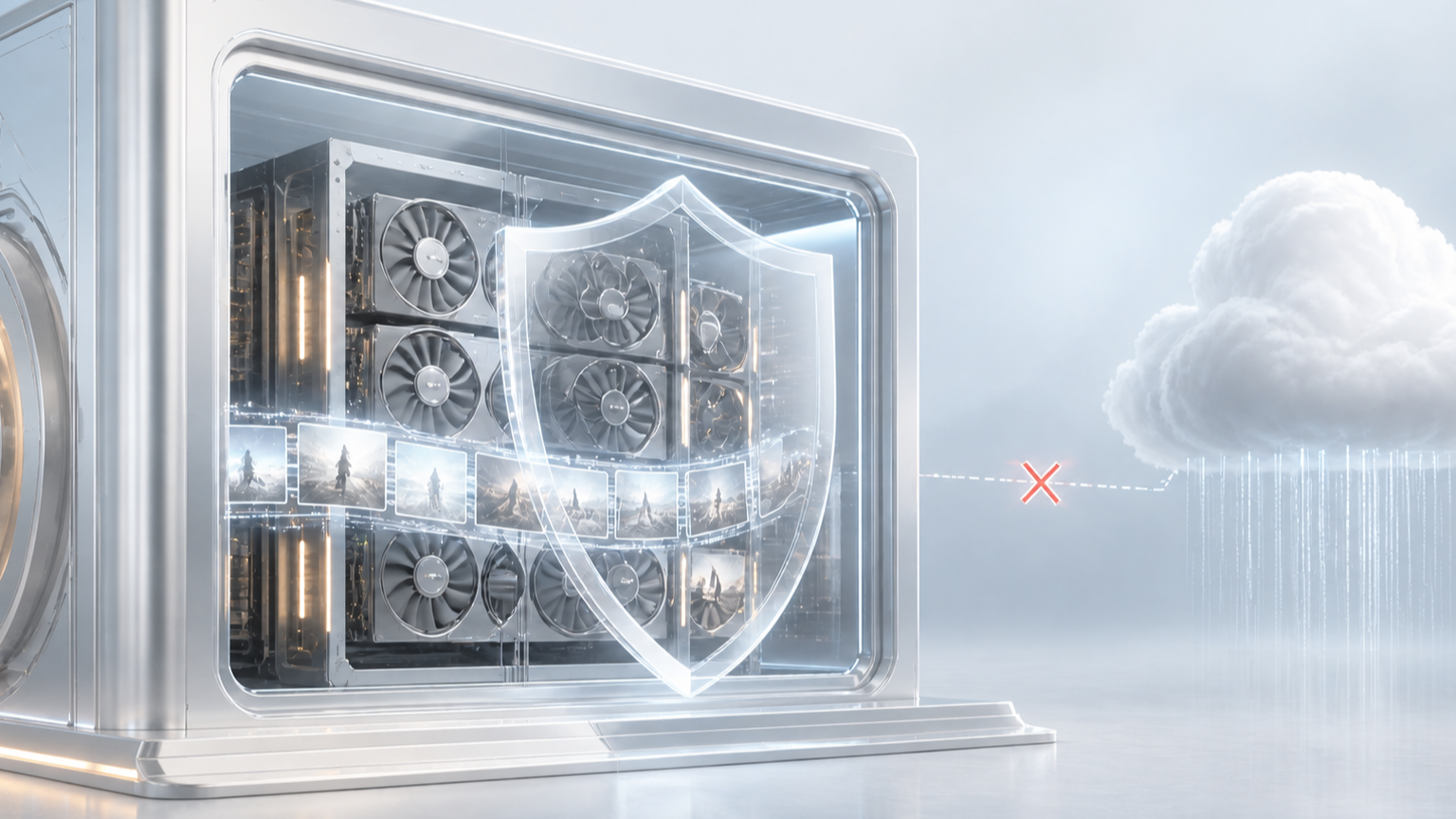
Illustrative composite of a common security-driven buying pattern.
A studio wins a campaign for a client whose legal and security terms are unusually strict: unreleased IP, a streamer or games publisher, the kind of brand whose material cannot leave controlled infrastructure. The creative brief is squarely in the studio's wheelhouse: AI-augmented motion graphics built in ComfyUI. The client's security reviewer will not sign off on assets being processed on shared public-cloud GPUs.
For a studio whose whole capacity story is "burst to the cloud," this is a wall. The very elasticity that handles their busy weeks is the thing this client forbids. And in 2026, buying a stack of high-VRAM cards to add owned capacity for one job is both expensive and slow. The cards are scarce and over MSRP.
The path through was infrastructure the studio owned and controlled. The renders ran on owned hardware, inside the studio's own network, on machines whose security posture could be documented to the client's reviewer. Nothing sensitive touched a shared environment. The same ComfyUI workflows the studio used everywhere else ran here unchanged, because the pipeline treated deployment as a configuration (owned, cloud, or a mix) rather than a rebuild. For this client, the configuration was "owned only."
Two things made this a selling point rather than a scramble. First, control was real and auditable: the studio owned the hardware, held its own model licences, and could show exactly where every frame was processed. That is a claim no public render farm can make, and it opened work the studio previously could not bid on. Second, because the pipeline abstracted deployment, going owned-only for one client did not mean maintaining a separate pipeline for them. It was the same submission layer, the same reproducible workflows, the same reporting, just a different routing policy.
Cloud burst and studio-owned rendering are two settings of one pipeline. A studio that can serve the spiky commercial job by bursting to cloud and the NDA-bound job by keeping everything on owned, documented hardware, without running two separate stacks, can bid on both.
More from the blog
- Critterz and the Retired Model: A Feature-Length Lesson in Tool Dependency
Critterz was pitched as an AI-assisted animated feature in about nine months for around $30 million. Its Cannes story is what happens when the video model in the pipeline is shut down.
- Wan 2.2 on a 6GB Card: A Real Low-VRAM Case Study
A community Wan 2.2 14B workflow generates a second of video on an RTX 3050 6GB in under five minutes. Here is the stacked technique set that makes that possible.