Workflow
A Reproducible Team Workflow: Registries, Pinning and Shared Queues
· RenderBob team
Single-seat ComfyUI is simple: one machine, one models folder, one artist who remembers what they did. That simplicity breaks at the second user. This blueprint is built to survive a team.
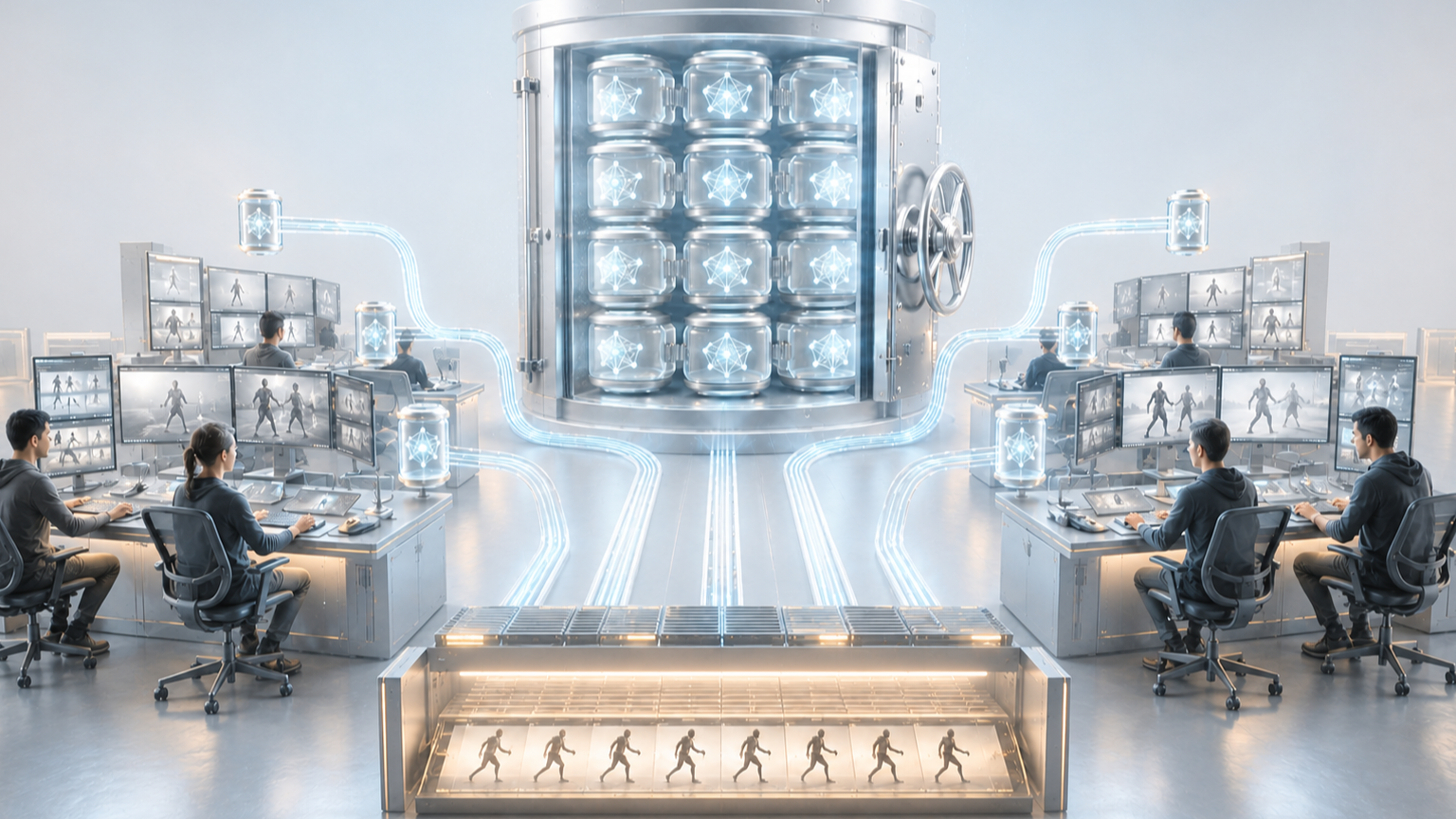
Single-seat ComfyUI is simple: one machine, one models folder, one artist who remembers what they did. That simplicity breaks at the second user. This blueprint is built to survive a team.
One shared model registry
Checkpoints, LoRAs and custom nodes live in one versioned, shared source of truth, not in per-artist folders. This kills duplication, version drift, and the "which checkpoint did you use?" conversation. Every workstation and every cloud node references the same registry at the same pinned versions.
Pin the full chain
Reproducibility in ComfyUI requires pinning ComfyUI itself, custom node versions, model versions, sampler, seed and settings. Treat the workflow definition as including its whole environment, not just the node graph.
Automatic run capture
Every execution from every artist saves complete state: nodes, settings, models, inputs, outputs. Not just the final image. This is what makes a teammate's result reusable: open it, change one value, rerun. It is also what makes "recreate that exact frame from last week" a lookup instead of a lost cause.
A shared queue
Instead of each artist tying up their own machine and improvising when it is busy, jobs go to a common queue that schedules across available capacity. This is the point where owned and cloud nodes become interchangeable destinations rather than separate worlds.
A promotion path for good workflows
When an artist finds a better approach, it becomes the pinned baseline for the team. One expert's judgement scales to everyone, and new hires inherit a library of known-good, reproducible workflows rather than a folder of mystery JSONs.
Governance as a first-class concern
Every model and node carries its own licence and training-data terms, and one restricted model can make an output commercially unsafe. A production team needs an approved model registry, enforcement that artists only use cleared models, and audit trails that survive a client's security review. That is what lets a studio say yes to enterprise clients.
Teams almost always discover this in the wrong order. They solve compute first (more GPUs), then model management, and only reach the reproducibility and provenance layer months later, usually after a lost asset or a client asking "can you recreate this exactly?" By then there is a backlog of ungoverned, unsearchable work, and retrofitting provenance costs far more than capturing it at creation. Build the reproducible layer early.
More from the blog
- Two Lanes of AI Editing: Mechanical Cleanup and Narrative Assembly
AI editing tools split into cleanup that follows story decisions and assembly that proposes them. A third question, local or cloud processing, now cuts across both.
- "Just Regenerate": The Bad-Seed Workaround Culture in AI Video Editing
While reference-guided video stays unreliable, working practice is blunt: do not commit a clip until you have looked, delete a stuck result, and switch models when one keeps missing.