Technical
From Prompt to Prop: 3D and World Generation in ComfyUI for Motion Graphics
· RenderBob team
Generative AI in ComfyUI started with images, moved to video, and is now reaching into three dimensions. Here is how image-to-3D and world models fit a motion-graphics pipeline, and where they do not yet.
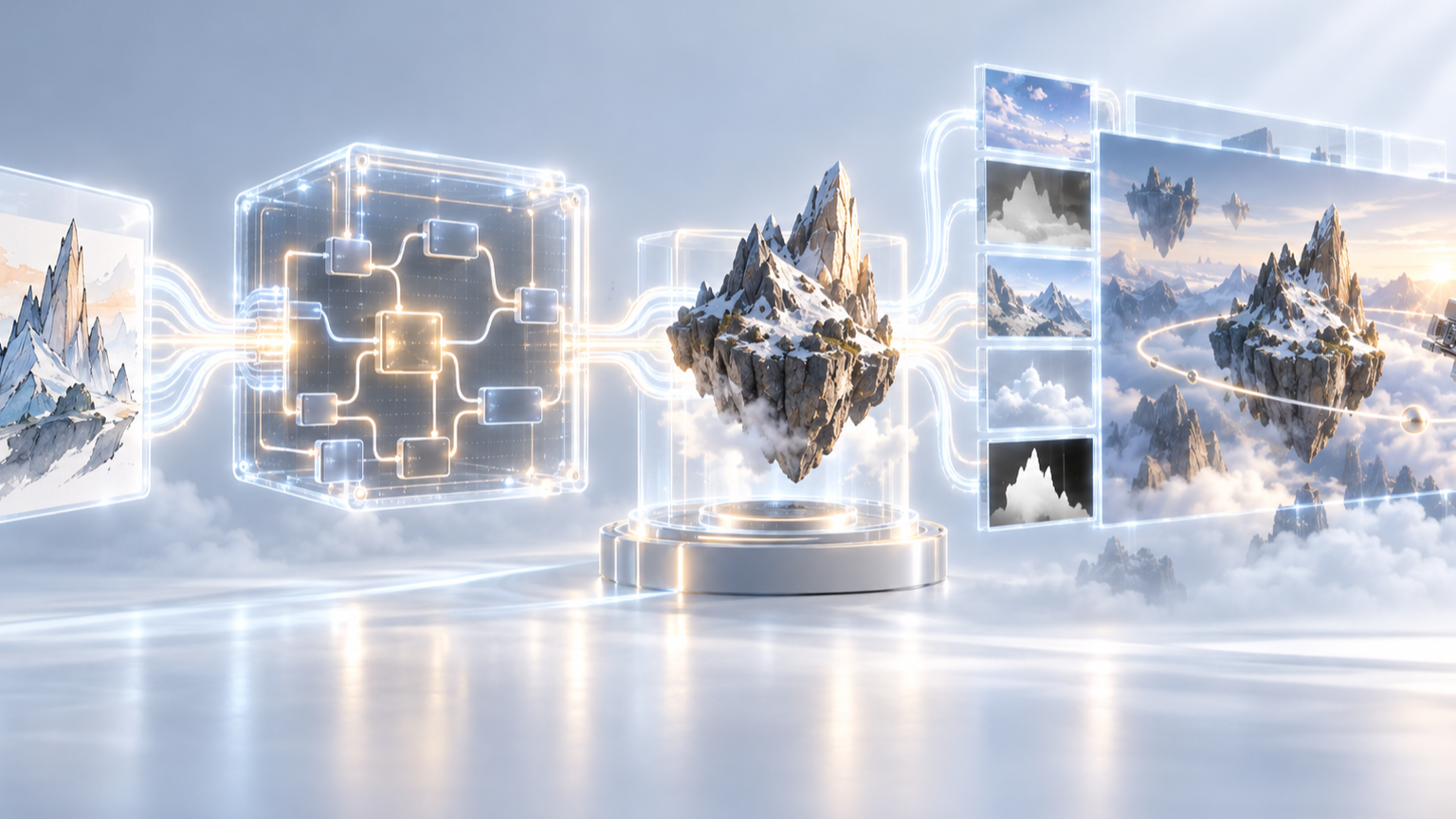
Generative AI in ComfyUI started with images, moved to video, and is now reaching into three dimensions. ComfyUI has added support for image- and text-to-3D models like Hunyuan3D, and NVIDIA's Cosmos-Predict2 world models are part of the local generative toolkit. For a motion-graphics studio that lives partly in classical 3D tools, this is an interesting and slightly awkward frontier worth understanding clearly.
The appeal is obvious. Motion graphics constantly needs assets, props, set dressing, background geometry, quick concept objects, and generating a rough 3D mesh from a prompt or a reference image is faster than modelling one from scratch. World-generation models point at something bigger still: generating coherent environments rather than single objects, which maps onto the establishing shots and background worlds a lot of motion work needs.
The realistic way to use this today is as a front end to a classical pipeline, not a replacement for it. Generated 3D output is a fast starting point, a base mesh, a concept, a blockout, that an artist cleans up, retopologises where topology matters, and brings into the DCC (Cinema 4D, say) for the precise animation, lighting and control that client work demands. Generative 3D is strong at "give me something roughly like this, quickly" and weak at "give me production-clean topology I can rig and deform predictably." Knowing which half of the job it is doing keeps expectations honest.
This blend, generative 3D and world models feeding classical motion-graphics tools, is the same shape as the video pipeline: some stages are generative and heavy, some are classical and precise, and the value is in wiring them into one smooth flow. And like the rest of the generative stack, 3D and world generation are compute-hungry. Generating meshes and especially environments is a VRAM- and time-intensive job that follows the familiar pattern: iterate on modest local hardware, and route the heavy generation pass to the machine, owned or cloud, that can actually hold it.
Generative 3D is earlier and rougher than generative image or video, and it is moving fast. For a motion studio, treat it as an accelerator for the concept-and-asset stage rather than a finished-geometry machine, and build the pipeline so that when the models get good enough to trust further, adding them is a configuration change, not a rebuild. The studios watching this frontier and wiring it in early will be the ones ready when 3D generation crosses from useful blockout to production asset.
More from the blog
- Human Authorship Is Becoming the Unit of Value
The Oscars' 2026 AI rules, Cannes' unpublished competition stance, a patchwork of festival policies, and the Thaler copyright denial all ask how much of a film a human authored.
- Ideation Is the Green Zone: Where Studios Allow AI and Where They Stop
Netflix's generative AI guidance for production partners treats concept work as the open case and final deliverables as the restricted one. That split is spreading as a working template.